
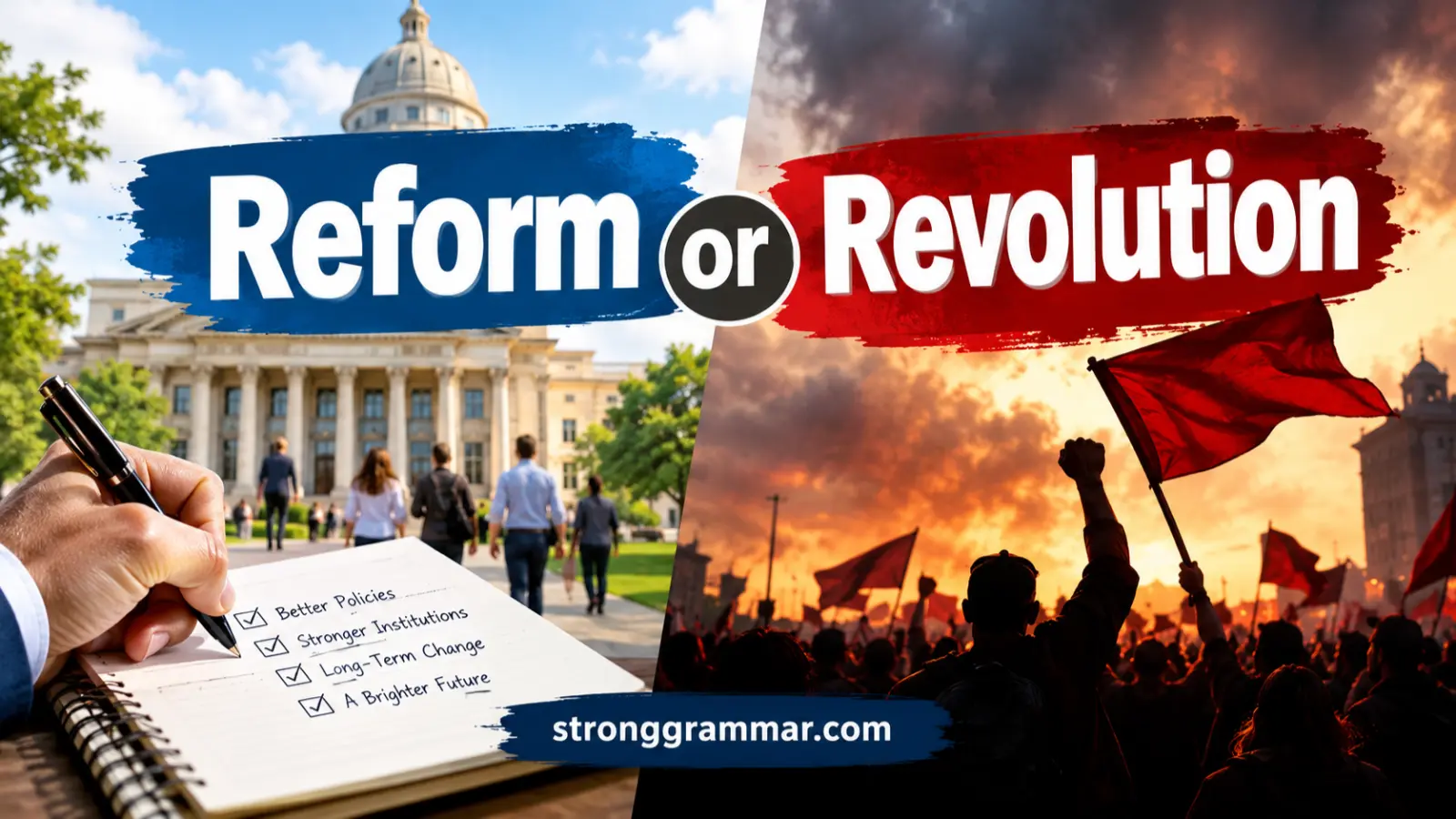
Reform or revolution describes two different ways to bring change to a society, government, or political system. Although both approaches aim to improve or transform existing conditions, they differ in how change happens and how much of the existing system remains in place. Understanding the difference helps you use these terms correctly in discussions about politics, history, and social change.
Reform means making changes to an existing system to improve how it works. These changes usually happen gradually through laws, policies, or established institutions. For example, a government might reform its education system by improving school funding or updating its curriculum.
Revolution, on the other hand, involves a more fundamental and often rapid transformation of political or social structures. It may replace an existing government or challenge the foundations of an established system. The French Revolution is one historical example of a major political and social transformation.
The choice between reform and revolution often depends on the problems people face, whether existing institutions can address them, and how much change they believe is necessary. In this article, you’ll learn what reform and revolution mean, explore their key differences, and see how to use both terms accurately in different contexts.
What Does Reform Mean?
Reform means making changes to an existing system, law, institution, or practice to improve it or correct its problems.
In politics, reform often happens through established processes, such as passing new laws, changing government policies, improving public services, or updating institutions.
The basic idea is to fix what is not working without necessarily replacing the entire system.
Examples of reform
- Education reform: Changing school policies or updating the curriculum to improve education.
- Political reform: Introducing measures to make elections fairer and government more accountable.
- Economic reform: Changing tax rules or business regulations to address economic problems.
- Social reform: Changing laws to protect people’s rights and reduce discrimination.
Example sentence: The government introduced education reforms to improve the quality of public schools.
In this example, the government aims to improve an existing education system rather than replace it completely.
What Does Revolution Mean?
Revolution means a fundamental or far-reaching change in a political, social, economic, or other established order.
In politics, a revolution often involves mass participation and an attempt to replace the existing government or transform the foundations of the political system. Depending on the circumstances, it may involve violence, but violence is not a necessary feature of every change described as revolutionary.
The central idea is that the change goes beyond adjusting individual laws or policies and transforms the system more deeply.
Examples of revolution
- Political revolution: A movement that removes an established regime and seeks to create a different political order.
- Social revolution: A profound transformation in social relationships, institutions, or class structures.
- Industrial Revolution: A major transformation in production and economic life through industrialization.
- Digital revolution: A broad transformation in communication, information, and everyday activities through digital technology.
Example sentence: The revolution transformed the country’s political institutions and changed who held power.
Unlike a limited policy change, this example describes a fundamental shift in the existing order.
Reform or Revolution: Key Differences
The difference between reform and revolution is mainly about how much changes, how change happens, and whether the existing system remains in place. The distinction is useful in politics, history, and discussions about social change, although real events do not always fit neatly into one category.
| Feature | Reform | Revolution |
|---|---|---|
| Meaning | Improving or changing an existing system | Fundamentally transforming an established order |
| Scope | Often limited to particular laws, policies, or institutions | Often affects the wider political or social structure |
| Method | Commonly uses established processes | May challenge or operate outside established processes |
| Speed | Often gradual, but can be rapid | Often associated with rapid change, though transformation may continue over years |
| Existing system | Usually retains its basic structure | May replace its basic structure |
| Violence | Often pursued peacefully | May be violent or nonviolent |
| Example | Introducing stronger anti-corruption laws | Replacing an established political regime |
These are general tendencies, not absolute rules. A reform can be far-reaching, and a revolution can begin peacefully or involve a long period of gradual change.
Real-Life Examples of Reform and Revolution
Historical examples make the distinction easier to understand.
1. Reform: Changing a law
Imagine that a country allows government officials to award public contracts without proper oversight. Citizens demand greater transparency, and the legislature passes new rules requiring public reporting and independent audits.
This is reform because the country changes its existing laws and procedures to address a problem without necessarily replacing its political system.
2. Revolution: Replacing a political order
The French Revolution, which began in 1789, transformed France’s political order and challenged the monarchy and the social structures associated with it. Its course included major political changes and periods of violence.
This is an example of revolution because the transformation went far beyond changing an individual law or government policy.
3. A technological revolution
The Industrial Revolution transformed how goods were produced, contributing to major changes in economic life, work, and society.
Here, revolution does not mean a political uprising. It means a sweeping transformation in how people live and work.
This example illustrates an important point: revolution has meanings beyond politics.
Reform or Revolution: Which Is Better?
Neither approach is automatically better. The answer depends on the problem, the available options, the institutions involved, and the likely consequences.
Reform may be preferable when:
- Existing institutions can respond effectively to problems.
- Changes can be achieved through laws, elections, negotiation, or public policy.
- Gradual implementation can reduce disruption.
- The system can be improved without replacing its foundations.
Revolution may be pursued when:
- Existing institutions are unable or unwilling to address deep-rooted problems.
- A movement seeks fundamental changes to the political or social order.
- Established channels for change are viewed as ineffective or illegitimate.
However, revolutions can bring uncertainty, instability, and serious human costs. Reforms can also fail, remain too limited, or leave deeper inequalities untouched. Neither approach guarantees a successful outcome.
The key question is not simply which form of change is more dramatic, but which changes are needed, how they can be achieved, and what consequences they are likely to produce.
Can Reform Lead to Revolution?
Yes. Reform and revolution are not always completely separate processes.
When reforms fail to address widespread grievances, public dissatisfaction may grow. Some movements may then demand more fundamental changes. In other cases, reforms can open new opportunities for political participation and help prevent revolutionary conflict.
The relationship depends on the historical circumstances. For example, research on the 1911 Chinese Revolution examines how late Qing reforms helped create new opportunities for political mobilization while also contributing to opposition among some groups.
This shows why it is too simple to assume that reform always prevents revolution or that revolution always begins because reform has failed.
Common Mistakes When Comparing Reform and Revolution
Avoid these common misunderstandings:
- Assuming reform means a small change: Reforms can have significant and lasting effects on society.
- Assuming every revolution is violent: Violence is common in some revolutionary events, but it is not essential to every use of the term.
- Confusing a change of leader with a revolution: Replacing a leader does not necessarily transform the political system.
- Assuming reform and revolution cannot overlap: A revolutionary process may include reforms, and far-reaching reforms may gradually transform a system.
- Thinking revolution always means improvement: Revolution describes the nature of change, not whether its results are beneficial.
FAQs:
1. What is the main difference between reform and revolution?
Reform changes or improves parts of an existing system, while revolution involves a fundamental transformation of an established political, social, or economic order.
2. Is reform gradual and revolution sudden?
Reform is often gradual, and revolution is often associated with rapid change. However, neither description is universal. Major reforms can happen quickly, while revolutionary transformations may take years to develop.
3. Is revolution always violent?
No. Some revolutions involve armed conflict, while others may rely heavily on mass protests, nonviolent resistance, and political mobilization. The term generally refers to the depth of transformation rather than violence alone.
4. What is an example of reform?
Passing legislation to improve election transparency, strengthen workplace protections, or improve public education are examples of reform within an existing system.
5. What is an example of revolution?
The French Revolution of 1789 is a major historical example because it fundamentally challenged France’s monarchy and traditional political and social order.
6. Can reform and revolution happen together?
Yes. A revolutionary movement can introduce reforms during a wider transformation, and a series of reforms can contribute to profound changes in society. The distinction depends on the overall process and the extent of the transformation.
7. What is the difference between reform and revolution in simple words?
Reform means fixing or improving the existing system. Revolution means fundamentally changing the system itself. This is a useful starting point, although real-world situations can be more complicated.
Conclusion:
Understanding reform or revolution comes down to recognizing how change takes place and how deeply it affects an existing system. Reform focuses on improving the system through adjustments, new policies, or gradual changes. Revolution seeks a more fundamental transformation and may replace established political, economic, or social structures.
Neither approach produces the same results in every situation. Reform can offer a way to address problems while maintaining institutional continuity, but it may be too limited when deeper structural changes are needed. Revolution can create opportunities for major transformation, although it may also bring instability, conflict, and uncertain outcomes.
The right term depends on the situation you are describing. If people are trying to improve an existing system through changes within its established structures, reform is usually the more accurate word. If they are seeking to fundamentally transform or replace that system, revolution may be more appropriate.
In history, politics, and everyday discussions, these terms help explain different approaches to change. Remembering their central distinction makes them easier to understand and use correctly: reform changes an existing system, while revolution seeks a more fundamental transformation.