
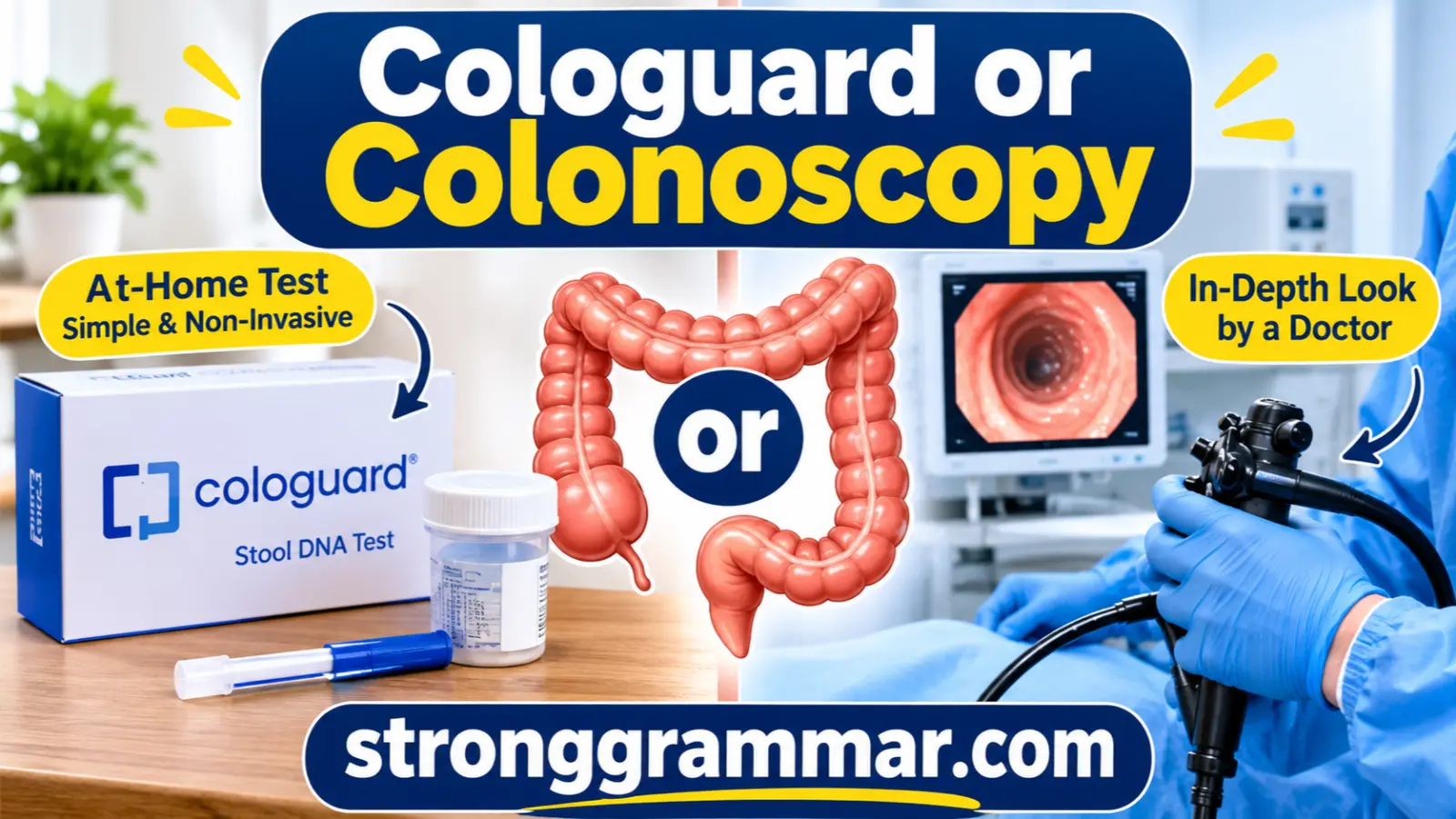
Choosing between Cologuard or colonoscopy can be confusing when you’re trying to find the right way to screen for colorectal cancer. Both tests help detect possible signs of the disease, but they work differently and offer different benefits. Cologuard is an at-home stool-based test that checks for certain DNA markers and hidden blood, while a colonoscopy allows a doctor to examine the inside of your colon using a small camera.
The biggest difference is convenience versus direct examination. Cologuard does not require bowel preparation or sedation, making it a convenient option for eligible adults at average risk. A colonoscopy, on the other hand, requires preparation but allows doctors to identify and remove certain polyps during the same procedure.
So, which option should you choose? The answer depends on your age, family history, medical background, and personal health needs. A test that works well for one person may not be suitable for someone with a higher risk of colorectal cancer.
In this guide, we’ll explain the differences between Cologuard and colonoscopy, including their accuracy, costs, preparation, benefits, and possible risks. By understanding how each screening method works, you can have a more informed conversation with your healthcare provider.
Quick Answer Cologuard or Colonoscopy?
Cologuard is an at-home stool DNA test that checks for certain DNA markers and hidden blood associated with colorectal cancer and advanced precancerous growths.
Colonoscopy is a medical procedure in which a doctor uses a flexible camera to examine the colon and rectum. The doctor can also remove certain polyps during the examination.
The main difference is that Cologuard looks for warning signs in a stool sample, while colonoscopy directly examines the colon.
- Choose Cologuard as a potential option if you are an eligible, average-risk adult who prefers noninvasive screening.
- Consider colonoscopy if you want direct examination of the colon and the opportunity to remove polyps during the same procedure.
- If Cologuard produces a positive result, a follow-up colonoscopy is necessary.
Neither option is automatically right for everyone. United States Preventive Services Taskforce+2
What Is Cologuard?
Cologuard is an at-home colorectal cancer screening test. It analyzes a stool sample for certain DNA markers and hidden blood that may be associated with colorectal cancer or advanced precancerous lesions.
Unlike a colonoscopy, you do not need to visit a hospital or undergo a camera examination to complete the initial test.
How Does Cologuard Work?
The process generally involves these steps:
- Get a test kit: Your healthcare provider determines whether Cologuard is appropriate and provides a prescription.
- Collect a stool sample: Follow the instructions included with the collection kit.
- Send the sample: Return the sample to the laboratory using the supplied shipping materials.
- Receive your results: The laboratory analyzes the sample and sends the results to your healthcare provider.
There are two possible main results:
- Negative: The test did not detect the targeted signs associated with colorectal cancer or advanced precancerous growths.
- Positive: The test detected signs that require further evaluation.
A negative result does not guarantee that cancer or precancerous growths are absent. Similarly, a positive result does not mean that you definitely have cancer.
Benefits of Cologuard
Some reasons people consider Cologuard include:
- Convenience: You can collect the sample at home.
- No bowel preparation: The initial stool test does not require the extensive cleansing needed before colonoscopy.
- No sedation: You do not need anesthesia or sedation to complete the stool collection.
- Noninvasive screening: There is no need to insert a camera into the colon.
- Privacy: You can collect the sample in your own home.
Disadvantages of Cologuard
Cologuard also has limitations worth understanding.
- It cannot directly examine the inside of your colon.
- It cannot remove polyps.
- False-positive and false-negative results can occur.
- A positive result requires a follow-up colonoscopy.
- It requires repeated screening according to the recommended schedule.
Cologuard is intended for eligible adults at average risk. It is not a replacement for diagnostic or surveillance colonoscopy in people who need those procedures. Indications for Use+1
What Is a Colonoscopy?
A colonoscopy is a medical examination that allows a doctor to inspect the inside of the entire colon and rectum using a thin, flexible instrument called a colonoscope.
The instrument has a small camera and light that help the doctor identify abnormalities, including polyps and suspicious tissue.
One important advantage is that doctors can often remove certain polyps during the same procedure. Removing precancerous polyps can help prevent some cases of colorectal cancer.
How Does a Colonoscopy Work?
A typical colonoscopy involves several steps.
- Preparation: You follow your doctor’s instructions to clean out your colon. This usually involves a special laxative preparation and temporary dietary changes.
- Arrival at the medical facility: You visit a hospital, clinic, or endoscopy center.
- Sedation: Most patients receive medication to make the procedure more comfortable.
- Examination: The doctor gently inserts the colonoscope and examines the colon and rectum.
- Polyp removal: If certain polyps or abnormal tissue are found, the doctor may remove them or collect samples for testing.
- Recovery: You spend some time recovering before going home. If you receive sedation, you generally need someone to drive you.
The procedure itself is often relatively short, although preparation and recovery require additional time.
Benefits of Colonoscopy
Colonoscopy offers several important advantages:
- Direct examination: Doctors can inspect the lining of the colon and rectum.
- Polyp removal: Certain abnormal growths can be removed during the examination.
- Biopsy: Suspicious tissue can be collected for laboratory testing.
- Longer screening interval: For eligible average-risk adults with a normal result, screening colonoscopy is generally recommended every 10 years.
- Follow-up examination: It can investigate abnormal results from stool-based screening tests.
Disadvantages of Colonoscopy
Despite its advantages, colonoscopy has some drawbacks.
- It requires bowel preparation.
- The procedure takes place in a medical facility.
- Sedation is commonly used.
- You may need someone to drive you home.
- It can cause temporary bloating or abdominal discomfort.
- There are uncommon but important risks, including bleeding and perforation of the colon.
The likelihood of complications can depend on age, medical history, and whether polyps are removed. NCI+1
Cologuard vs Colonoscopy Key Differences
Both tests help screen for colorectal cancer, but their methods, preparation requirements, and capabilities are different.
Here is a simple comparison:
| Feature | Cologuard | Colonoscopy |
|---|---|---|
| Test type | Stool DNA test | Medical examination |
| Location | At home | Medical facility |
| Method | Analyzes stool | Examines the colon directly |
| Bowel preparation | Not required | Required |
| Sedation | Not required | Usually used |
| Detects certain cancer-related signs | Yes | Yes, through visual examination |
| Removes polyps | No | Yes, certain polyps |
| Biopsy | No | Yes |
| Positive result | Requires colonoscopy | Further evaluation depends on findings |
| Screening frequency | Generally every 1–3 years under USPSTF guidance | Every 10 years after a normal screening examination for average-risk adults |
| Invasive procedure | No | Yes |
United States Preventive Services Taskforce+2
Which Is More Accurate: Cologuard or Colonoscopy?
Accuracy is one of the most important considerations when comparing these screening methods.
However, accuracy does not mean exactly the same thing for both tests.
Cologuard looks for specific signals in stool, whereas colonoscopy allows a doctor to examine the colon directly and identify visible abnormalities.
Colo guard Accuracy
Cologuard can detect certain DNA markers and hidden blood associated with colorectal cancer and advanced precancerous lesions.
However, it can produce:
False positives: The result is positive even though the follow-up examination does not identify the targeted cancer or advanced precancerous growth.False negatives: The test produces a negative result even though an abnormality is present.
This is why a negative result should not be treated as a guarantee that everything is normal.
Colonoscopy Accuracy
Colonoscopy allows doctors to examine the colon directly. It can identify many polyps and suspicious abnormalities that stool tests cannot locate or remove.
However, colonoscopy is not perfect either.
Some abnormalities can be missed, and the quality of the examination depends on factors such as bowel preparation and the quality of the procedure.
So, Which Is More Accurate?
Colonoscopy provides direct visualization and the ability to remove certain polyps, making it particularly useful for identifying and managing abnormalities.
Cologuard offers a convenient screening alternative, but it does not provide the same direct examination or treatment opportunity.
The tests are not interchangeable in every situation. The appropriate choice depends on individual risk and clinical circumstances. United States Preventive Services Taskforce+1
Cologuard or Colonoscopy: Which Is Better for Different People?
The best option depends on your personal circumstances rather than convenience alone.
1. For People Who Prefer At-Home Testing
Cologuard may be appealing if you qualify for average-risk screening and prefer collecting a sample at home.
It avoids the bowel preparation, sedation, and medical procedure associated with colonoscopy.
However, you must still complete future screening as recommended and follow up on any positive result.
2. For People Who Want Polyps Removed
Colonoscopy is generally the more appropriate option when the goal includes directly identifying and removing polyps.
Cologuard cannot remove abnormal growths. If its result is positive, a colonoscopy is needed to investigate the finding.
3. For People With a Family History of Colorectal Cancer
Your family history matters when selecting a screening test.
Cologuard is not intended for people with a personal or first-degree family history of colorectal cancer under its current product indications.
People with increased risk may need earlier or more frequent colonoscopy screening.
Discuss your family history with a healthcare professional before choosing a test. Indications for Use+1
4. For People Who Want Less Frequent Screening
For eligible average-risk adults, a normal colonoscopy generally allows a 10-year interval before the next screening.
Cologuard requires more frequent testing.
According to USPSTF guidance, stool DNA-FIT screening is recommended every one to three years, while screening colonoscopy is recommended every 10 years for average-risk adults with normal findings.
The exact interval should be confirmed with your healthcare provider. United States Preventive Services Taskforce+1
What Happens If Cologuard Is Positive?
A positive Cologuard result can be worrying, but it does not automatically mean you have colorectal cancer.
It means the test detected certain signals that require additional investigation.
Your healthcare provider will generally recommend a follow-up colonoscopy.
During that examination, the doctor can:
- Look for polyps.
- Examine suspicious areas.
- Remove certain abnormal growths.
- Collect tissue samples if necessary.
Sometimes, the colonoscopy does not find cancer or advanced precancerous growths. This can happen because Cologuard can produce false-positive results.
Important: Do not ignore a positive result simply because you feel healthy. Arrange the recommended follow-up with your healthcare provider. Indications for Use+1
Can You Choose Cologuard Instead of a Colonoscopy?
In some situations, yes.
For eligible adults at average risk who have no symptoms, Cologuard may be an acceptable screening option.
However, it is not appropriate for everyone.
Colonoscopy may be necessary if:
- You have a positive Cologuard result.
- You have a history of certain colon polyps.
- You have a personal or first-degree family history of colorectal cancer.
- You have inflammatory bowel disease.
- Your doctor recommends diagnostic testing because of concerning symptoms.
People with a higher risk of colorectal cancer may need a different screening approach.
Remember that screening and diagnostic testing are not the same thing. Screening looks for possible disease in people without symptoms, while diagnostic testing investigates a particular concern.
At What Age Should You Get Cologuard or a Colonoscopy?
In the United States, the USPSTF recommends colorectal cancer screening for most average-risk adults beginning at age 45.
Its recommendations include:
- Ages 45–75: Routine colorectal cancer screening is recommended.
- Ages 76–85: Screening decisions should be individualized based on health, previous screening, and personal preferences.
- Over age 85: Routine screening is generally not recommended under major US screening guidance.
For eligible adults, both stool DNA-FIT testing and colonoscopy are among the recommended screening strategies.
People with certain risk factors may need to begin screening earlier.
These age recommendations are based on US guidance and may differ in other countries. United States Preventive Services Taskforce+1
What Are the Risks of Cologuard and Colonoscopy?
Both screening options have limitations, but their risks are different.
Cologuard Risks
The collection process is noninvasive, so its physical risks are generally low.
However, the main limitations include:
- False-positive results.
- False-negative results.
- Delays in diagnosis if a negative result creates false reassurance.
- The need for colonoscopy after a positive result.
Colonoscopy Risks
Colonoscopy is generally considered a safe procedure, but complications can occur.
Possible risks include:
- Bleeding, particularly after polyp removal.
- Perforation of the colon.
- Reactions to sedation.
- Temporary abdominal discomfort.
- Complications related to bowel preparation.
The benefits and risks should be considered together, particularly for older adults and people with other medical conditions. United States Preventive Services Taskforce+1
Can Cologuard Replace a Colonoscopy?
Cologuard can serve as an alternative screening method for certain average-risk adults, but it cannot completely replace colonoscopy.
The distinction is important.
Cologuard detects certain signs associated with colorectal cancer and advanced precancerous lesions. It does not show where an abnormality is located, remove polyps, or collect tissue for biopsy.
Colonoscopy can perform these additional functions.
Also, anyone with a positive Cologuard result needs a follow-up colonoscopy.
Therefore, Cologuard is an alternative to an initial screening colonoscopy for eligible individuals, not a substitute for every reason a colonoscopy might be medically necessary.
FAQs:
1. Is Cologuard as good as a colonoscopy?
Not in every respect. Cologuard is a convenient stool-based screening test, while colonoscopy directly examines the colon and can remove certain polyps. They serve different purposes and are appropriate for different circumstances.
2. Is Cologuard less invasive than a colonoscopy?
Yes. Cologuard only requires collecting and submitting a stool sample. Colonoscopy involves bowel preparation and inserting a flexible camera into the colon, usually with sedation.
3. If Cologuard is negative, do I still need a colonoscopy?
A negative result does not automatically mean you need an immediate colonoscopy. However, it also does not guarantee that cancer or precancerous growths are absent. You should follow your healthcare provider’s recommended screening schedule.
4. What percentage of Cologuard tests are false positive?
The false-positive rate depends on the specific test version and the population being screened. It is not appropriate to apply one percentage to every patient or version of the test. Ask your healthcare provider about the performance data for the specific test being used.
5. Does Cologuard detect polyps?
Cologuard can detect certain DNA markers and hidden blood associated with advanced precancerous growths. However, it cannot directly identify, locate, or remove individual polyps.
6. Does a positive Cologuard result mean cancer?
No. A positive result means the test detected signals that need further investigation. A colonoscopy is needed to determine whether cancer, advanced precancerous growths, or another finding is present.
7. How often should you get Cologuard?
US Preventive Services Task Force guidance includes stool DNA-FIT screening every one to three years for eligible average-risk adults. Follow the schedule recommended for your particular test and medical circumstances.
8. How often should you get a colonoscopy?
For average-risk adults with a normal screening colonoscopy, the commonly recommended interval is every 10 years. People with polyps, a family history, or other risk factors may need more frequent examinations.
9. Can you get Cologuard if you have a family history of colon cancer?
Cologuard’s current product indications exclude people with a first-degree family history of colorectal cancer. These individuals should discuss appropriate screening options with their healthcare provider.
10. Which is cheaper, Cologuard or colonoscopy?
The actual cost depends on insurance coverage, location, healthcare facility, and whether additional procedures are needed. A positive Cologuard result may lead to the additional cost of a follow-up colonoscopy. Check your coverage before choosing either option.
Conclusion:
Choosing between Cologuard or colonoscopy depends on your health needs, personal preferences, and risk of colorectal cancer. Both screening methods can help detect potential signs of the disease, but they serve different purposes. Cologuard offers a convenient, noninvasive way to screen at home, while colonoscopy provides a direct examination of the colon and allows doctors to remove certain polyps during the procedure.
For eligible adults at average risk, Cologuard may be a suitable option if they prefer to avoid bowel preparation and an invasive examination. However, it requires regular repeat testing, and a positive result must be followed by a colonoscopy. Colonoscopy may be more appropriate for people with certain risk factors, a history of polyps, or symptoms that require medical investigation.
There is no single screening method that is best for everyone. Your age, family history, previous screening results, and overall health should all be considered before making a decision.
Ultimately, the most important step is not to delay colorectal cancer screening. Talk with your healthcare provider about the advantages and limitations of both options. Choosing an appropriate screening method and following the recommended schedule can help you take an important step toward protecting your long-term health.