
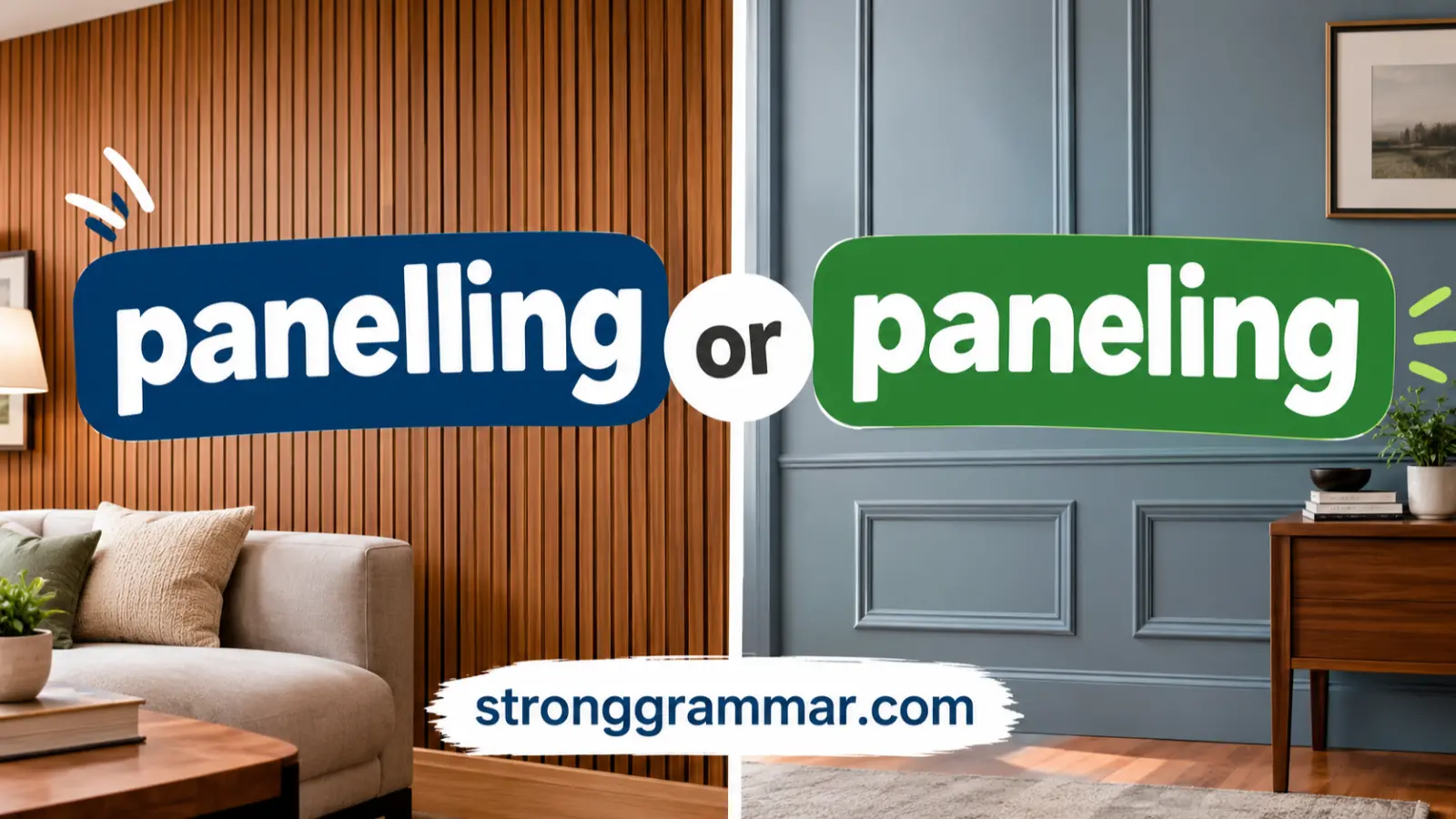
If you are unsure whether to write panelling or paneling, the good news is that both spellings are correct. The difference lies in regional English conventions, not meaning. Panelling is the preferred spelling in British English, while paneling is the standard spelling in American English. Both words refer to panels or a covering made from panels, often used on walls, ceilings, doors, and other surfaces.
These words can be confusing because they look slightly different but describe the same thing. For example, a British homeowner might choose decorative wooden panelling for a living room, while an American homeowner would typically call it wooden paneling. Neither version is wrong when used according to the appropriate spelling convention.
Understanding this difference helps you choose the right spelling for your audience. Whether you are writing a home improvement article, describing an interior design project, or preparing a professional document, consistency is important. Using the spelling preferred by your readers makes your writing clearer and more natural.
In this guide, you will learn what panelling and paneling mean, how their spellings differ, and when to use each version. You will also find practical examples to help you recognize and use both forms confidently.
What Does Panelling Mean?
Panelling is the British English spelling of the noun that describes panels collectively or the material used to cover a surface. It commonly refers to decorative or protective panels fitted to walls, ceilings, doors, and other surfaces.
Panelling is often made from wood, although other materials can also be used. It can improve the appearance of a room, cover part of a wall, or provide a finished surface.
Examples of Panelling in Sentences
- The living room features elegant oak panelling.
- They installed decorative panelling along the hallway walls.
- The old house still has its original wooden panelling.
- White panelling gave the bedroom a clean, traditional appearance.
- The contractor repaired the damaged panelling before painting the room.
In each example, panelling refers to panels or a surface covered with panels.
When Should You Use Panelling?
Use panelling when writing in British English or following a British English style guide.
For example:
- The hotel has beautiful wooden panelling throughout its main hall.
- We are considering wall panelling for the renovation.
- The original panelling was carefully restored.
This spelling is also appropriate in other writing contexts that follow British spelling conventions.
What Does Paneling Mean?
Paneling is the American English spelling of the same word. It has the same meaning as panelling and can refer to decorative panels, wall coverings, or material used to create a paneled surface.
In American English, the single l before the ending -ing is the usual spelling.
Examples of Paneling in Sentences
- The living room has attractive oak paneling.
- We chose white paneling for the bedroom walls.
- The contractor replaced the damaged paneling.
- The house features decorative paneling around the fireplace.
- She wants to install wood paneling in her home office.
These sentences mean the same thing they would if paneling were replaced with panelling.
When Should You Use Paneling?
Use paneling when writing in American English or following an American English style guide.
For example:
- The house has beautiful wooden paneling.
- We hired a contractor to install wall paneling.
- The original paneling was removed during the renovation.
If your audience is primarily American, this spelling will generally be the more appropriate choice.
Panelling vs Paneling Key Differences.
The difference between panelling and paneling is spelling, not meaning. Both words refer to the same thing.
| Feature | Panelling | Paneling |
|---|---|---|
| Preferred spelling | British English | American English |
| Meaning | Panels or a surface covered with panels | Panels or a surface covered with panels |
| Part of speech | Noun; also a verb form | Noun; also a verb form |
| Pronunciation | Generally the same | Generally the same |
| Typical context | British publications and writing | American publications and writing |
| Example | The walls have wooden panelling. | The walls have wooden paneling. |
The main difference is the extra l in the British spelling.
Why Are There Two Spellings?
The difference comes from regional spelling conventions in English.
British English commonly retains the double l when forming panelling from panel. American English generally uses a single l, producing paneling.
This pattern also appears in related forms of the verb panel:
- British English: panelled
- American English: paneled
- British English: panelling
- American English: paneling
These differences follow established regional spelling conventions. They do not create a difference in the underlying meaning.
How to Choose the Correct Spelling
Choosing between panelling and paneling is straightforward once you know your audience.
1. Consider Your Audience
If you are writing for British readers, use panelling. If you are writing for American readers, use paneling.
For example:
British English: The architect recommended decorative wall panelling.
American English: The architect recommended decorative wall paneling.
Both sentences are correct.
2. Follow Your Publication’s Style Guide
If you are writing an article, report, product description, or other professional document, follow the spelling conventions required by the publication or organization.
Consistency is more important than treating one regional spelling as universally correct.
3. Keep Your Spelling Consistent
Avoid switching between British and American spellings unnecessarily within the same piece of writing.
For instance, if your article uses British English, write panelling consistently unless you are quoting an original source or preserving an official product name.
Similarly, use paneling throughout a document written in American English.
Common Mistakes to Avoid
Although both spellings are correct, a few common misunderstandings can cause confusion.
Mistake 1: Assuming panelling is incorrect.
Incorrect assumption: “Panelling is a misspelling of paneling.”
Correction: Both are accepted spellings. Panelling is standard in British English, while paneling is standard in American English.
Mistake 2: Assuming the words have different meanings.
Incorrect assumption: “Panelling is decorative, but paneling is structural.”
Correction: The spelling alone does not create this distinction. Both words can describe panels used for decorative or practical purposes.
Mistake 3: Mixing spelling conventions without a reason.
If you are writing in British English, prefer panelling. If you are writing in American English, prefer paneling.
Mistake 4: Changing the spelling inside a direct quotation.
If a quotation or official product name uses one spelling, preserve its original wording when accuracy requires it.
FAQs:
1. Is panelling or paneling correct?
Both are correct. Panelling is the standard British English spelling, while paneling is the standard American English spelling.
2. Is panelling British or American English?
Panelling is the preferred spelling in British English. American English generally uses paneling.
3. Does panelling mean the same as paneling?
Yes. Both words have the same meaning. They refer to panels collectively, the material used to make panels, or a surface covered with panels.
4. Is wooden panelling or wooden paneling correct?
Both expressions are correct. Use wooden panelling in British English and wooden paneling in American English.
5. Is wall panelling or wall paneling correct?
Both are correct. British English generally uses wall panelling, while American English generally uses wall paneling.
6. How do you spell panelling in American English?
The usual American English spelling is paneling, with one l before -ing.
7. How do you spell paneling in British English?
The usual British English spelling is panelling, with two ls before -ing.
8. Is panelling a noun or a verb?
Panelling can function as a noun or as the present participle of the verb panel. As a noun, it refers to panels or a paneled surface. As a verb form, it describes the process of fitting or covering something with panels.
Conclusion:
The difference between panelling and paneling is simple: both spellings are correct, but they follow different regional conventions. Panelling is generally preferred in British English, whereas paneling is the usual spelling in American English. Both refer to panels or a surface covered with panels, and neither spelling has a different meaning simply because it contains an extra letter.
When deciding which version to use, consider your target audience and the type of English used throughout your writing. If you are writing for British readers, choose panelling.
If your audience is primarily American, use paneling. Following the spelling conventions of your publication or organization is also a good way to maintain consistency.
For example, wooden panelling is the conventional British spelling, while wooden paneling is standard in American English. Both expressions are appropriate in their respective contexts.
Ultimately, there is no need to worry about one spelling being universally better than the other. The important thing is to understand the regional difference and use the appropriate form consistently.
Once you recognize this pattern, choosing between panelling and paneling becomes easy. Keep your audience in mind, follow the relevant style guide, and you can use either spelling confidently in your writing.